
Pharmacodynamics in Simple Terms
Pharmacodynamics is a branch of pharmacology that focuses on what a drug does to the body. When a person takes a drug, it doesn’t just float around aimlessly—it interacts with different parts of the body and causes certain effects. Pharmacodynamics explains these effects, how they happen, and why they happen. It also looks at how much of a drug (dose) is needed to get a certain effect, and how drugs can change each other’s effects when taken together.
Key Principles of Drug Action
Let’s begin with a basic idea: drugs don’t create new functions in the body. They can’t make a cell or organ do something it wasn’t already capable of. Instead, drugs either speed up or slow down what’s already happening inside your body. This simple action can lead to big changes, both helpful and harmful. Here are the main types of drug actions:
1. Stimulation
This means a drug increases the activity of certain cells or organs.
Examples:
- Adrenaline increases heart rate and is used in cardiac arrest.
- Pilocarpine increases saliva flow in patients with dry mouth.
- Caffeine stimulates brain activity, increasing alertness.
- Amphetamines increase central nervous system (CNS) activity, often used in ADHD.
Too much stimulation can be dangerous—it may cause overactivity, followed by exhaustion.
Example: Picrotoxin, a CNS stimulant, in high doses, can cause seizures and then coma or respiratory failure.
2. Depression
This is the opposite of stimulation. It means slowing down the activity of specific cells or organs.
Examples:
- Barbiturates depress brain activity—used to treat seizures or for sedation.
- Quinidine reduces the excitability of the heart—used in arrhythmias.
- Omeprazole decreases acid production in the stomach—used for ulcers and reflux.
- Alcohol is a general CNS depressant in higher doses.
Some drugs can stimulate one part of the body while depressing another.
Example: Acetylcholine stimulates intestinal movement but slows down the SA node of the heart, reducing heart rate.
3. Irritation
Irritation refers to the rough or damaging effect of certain drugs on tissues, especially those that are less specialized, like skin or mucous membranes.
Examples:
- Capsaicin cream causes mild irritation and warmth—used in joint or nerve pain.
- Mustard oil and other counterirritants increase blood flow and reduce pain by irritating the skin.
- Phenol or carbolic acid causes tissue corrosion—used cautiously in disinfectants.
Strong irritation may cause inflammation, tissue death, or ulcers.
4. Replacement
Sometimes the body lacks certain substances, and drugs can help by replacing them.
Examples:
- Levodopa replaces dopamine in Parkinson’s disease.
- Insulin is given to patients with type 1 diabetes.
- Thyroxine is used in hypothyroidism.
- Vitamin B12 injections help treat pernicious anemia.
- Iron supplements treat iron-deficiency anemia.
5. Cytotoxic Action
Some drugs are made to kill harmful cells—like cancer cells or invading microorganisms—while sparing healthy human cells.
Examples:
- Penicillin destroys bacterial cell walls without harming human cells.
- Chloroquine targets the malaria parasite inside red blood cells.
- Cyclophosphamide kills fast-dividing cancer cells.
- Zidovudine (AZT) inhibits HIV replication.
- Albendazole targets worms in parasitic infections.
How Do Drugs Work? Mechanisms of Drug Action
While some drugs act through simple physical or chemical actions, most work by interacting with specific biological targets in the body—usually proteins. These targets help the drug know where to act and allow it to have precise effects.
Drugs with Simple Actions
Some drugs don’t need to interact with proteins. They work because of their physical or chemical nature.
Examples:
- Isabgol (ispaghula husk) acts as a bulk laxative by increasing stool volume.
- Antacids like aluminum hydroxide or magnesium hydroxide neutralize stomach acid.
- Activated charcoal binds toxins in poisoning cases.
- Mannitol draws water out of the brain in cerebral edema through osmotic action.
- Iodine-131 treats thyroid cancer via radiation.
- Dimethicone reduces gas bubbles in the stomach by lowering surface tension.
These drugs work without binding to specific proteins or receptors.
Drugs Acting on Specific Targets (Proteins)
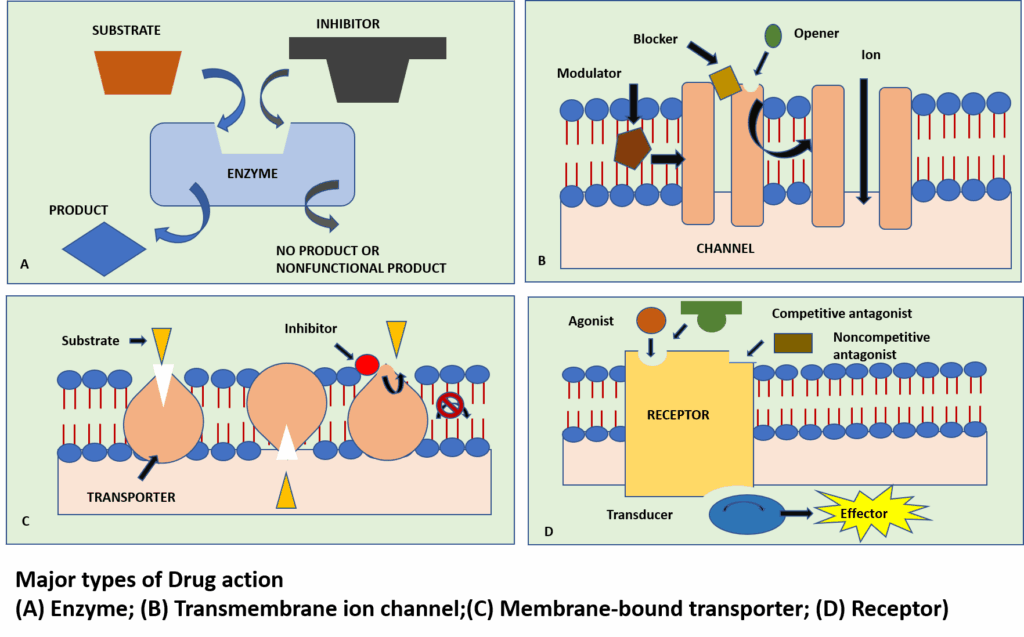
Most drugs work by binding to specific proteins. These proteins may be:
- Enzymes
- Ion Channels
- Transporters
- Receptors
1. Enzymes
Enzymes are proteins that speed up chemical reactions. Drugs can either inhibit (block) or enhance enzyme activity.
Enzyme Inhibitors
These drugs block enzymes by binding to them.
Examples:
- Sulfonamides block folic acid synthesis in bacteria.
- Methotrexate blocks an enzyme involved in DNA formation—used in cancer and autoimmune disease.
- Aspirin inhibits cyclooxygenase (COX)—reduces pain and inflammation.
Enzyme Activators
Rare in drugs. Usually involve cofactors like vitamins.
Example:
- Vitamin B6 (pyridoxine) helps enzymes involved in neurotransmitter production.
2. Ion Channels
Ion channels control the movement of ions like sodium, potassium, and calcium across cell membranes.
Examples:
- Lidocaine blocks sodium channels in nerves—used as a local anesthetic.
- Nifedipine blocks calcium channels in blood vessels—used in high blood pressure.
- Sulfonylureas block potassium channels in the pancreas—stimulate insulin release.
- Nicorandil opens potassium channels—used in angina.
- Amiloride blocks sodium channels in kidney tubules—used as a diuretic.
3. Transporters
Transporters move substances across membranes. Drugs can block these to change the concentration of key chemicals.
Examples:
- Fluoxetine (Prozac) blocks serotonin transporter (SERT) → increases serotonin levels → treats depression.
- Desipramine blocks norepinephrine transporter (NET).
- Furosemide inhibits Na⁺-K⁺-2Cl⁻ transporter in the kidney → causes fluid loss.
- Probenecid blocks uric acid transporter → used in gout.
- Tiagabine blocks GABA transporter → used in epilepsy.
4. Receptors
Receptors are proteins that receive signals like hormones or neurotransmitters. Drugs may activate or block them.
Agonist: Activates receptor like natural ligand.
Example: Morphine activates opioid receptors → pain relief.
Antagonist: Blocks receptor, preventing action.
Example: Atropine blocks muscarinic receptors → increases heart rate.
Partial agonist: Activates receptor but only partially.
Example: Buprenorphine in opioid addiction.
Inverse agonist: Produces opposite effect of an agonist.
Example: DMCM on benzodiazepine receptors → causes anxiety.
Ligand: Any molecule (agonist or antagonist) that binds to a receptor.
Theories Behind Drug-Receptor Action
1. Occupation Theory
The more receptors a drug occupies, the greater the effect—but the drug must also activate the receptor.
Key Concepts:
- Affinity = ability to bind
- Efficacy = ability to activate
Examples:
- Adrenaline: High affinity and high efficacy → full effect
- Propranolol: High affinity, zero efficacy → blocks beta receptors
- Pentazocine: Medium efficacy → partial agonist
- Chlorpheniramine: May act as inverse agonist on H1 receptors
2. Two-State Receptor Model
Receptors switch between:
- Ra (Active): Ready to produce a response
- Ri (Inactive): Resting state
Examples:
- Agonist: Binds Ra → activates receptor (e.g., salbutamol for asthma)
- Antagonist: Binds both Ra and Ri → blocks response (e.g., loratadine)
- Inverse Agonist: Binds Ri → reduces activity (e.g., DMCM)
- Partial Agonist: Slightly favors Ra → weak response (e.g., buprenorphine)
Some receptors like those for histamine H2 or benzodiazepines are partially active even without a drug (constitutive activity). Inverse agonists help turn them off.
Conclusion
Pharmacodynamics helps us understand how drugs produce effects, how much is needed, and how they interact with enzymes, ion channels, transporters, or receptors. By knowing whether a drug stimulates, blocks, replaces, or kills certain cells, we can better predict how it will help or harm the patient. Understanding these principles helps in choosing the right medicine, right dose, and preventing side effects or interactions.
Knowing pharmacodynamics shows us that even a small tablet can have a big, powerful impact inside the body—all thanks to the science of how drugs work.
References
Latest Editions of
- Rang H. P., Dale M. M., Ritter J. M., Flower R. J., Rang and Dale’s Pharmacology,.Churchil Livingstone Elsevier
- K.D.Tripathi. Essentials of Medical Pharmacology, JAYPEE Brothers Medical Publishers (P) Ltd, New Delhi.
- Sharma H. L., Sharma K. K., Principles of Pharmacology, Paras medical publisher